 |
Information
on
EVL for students of the Politecnico di Milano |
 |
What is EVL
EVL
is the
Electronic Visualization
Laboratory in the
Department of
Computer Science in the
College
of Engineering at the
University of
Illinois at Chicago in Chicago,
IL. EVL is an
interdisciplinary graduate research laboratory that combines
art and computer science, specializing in advanced visualization and
networking technologies. The laboratory was founded in 1973. It is a
joint effort of UIC's
College of Engineering and the School of Art & Design, representing
the oldest formal university collaboration between engineering and art
in the
United States, offering graduate degrees in electronic visualization
(MFA, MS, PhD.)
UIC
Computer Science Courses
related to EVL
note that most of these courses have prerequisites, but for
graduate students it is typical for the instructor to waive those
requirements if the student has enough relevant knowledge. For all of
the EVL-related courses the only real prerequisites are an ability to
program in a high-level language like C/C++/Java/Python.
* credit for
Computer Graphics II does not currently transfer to the
Politecnio
EVL Faculty
Jason Leigh
|
Advanced Networking
Video Game Development
AdvancedCollaborative Environments
Virtual Reality
|
 |
Andrew Johnson
|
Advanced Collaborative
Environments
Scientific Visualization
Virtual Reality
Learning Environments
|
 |
Thomas Moher
|
Learning Environments
Human-Computer Interaction
|
 |
Robert Kenyon
|
Human-Factors
Virtual Reality
|
 |
Luc Renambot
|
Advanced Networking
Scientific Visualization
|
 |
EVL Hardware
EVL
has a variety of
virtual reality devices which we have developed over the last 15 years
making use of stereoscopic projection, head tracking, and tracked
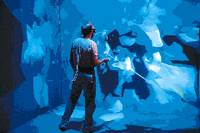
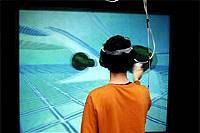
controllers. Currently our CAVE(tm) is being refurbished, but we have a
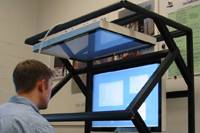
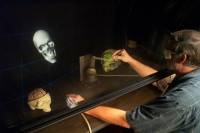
single-screen C-Wall, the 4-megapixel ImmersaDesk 4, and the PARIS
which is a
drafting-table sized display with a haptic SensAble PHANTOM as an input
device. We have also developed low-cost non-tracked stereoscopic
displays such as the GeoWall (www.geowall.org).
CAVE
|
C-Wall
|
ImmersaDesk 4
|
PARIS
|
We
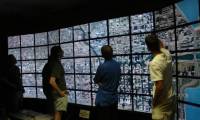
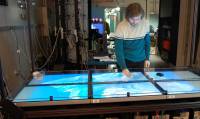
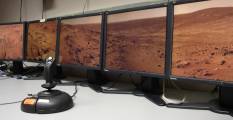
have several LCD
tile display systems including the 11x5 100-megapixel LambdaVision
display driven by a 28 node Opteron cluster with 1.5 TB of local
storage, the 24-megapixel LambdaTable, and a several single-PC based
tile displays.
LambdaVision
|
LambdaTable
|
Single PC-based systems
|
We
are also working
on combining these technologies into high-resolution auto-stereoscopic
tiled
displays (stereo viewing without special glasses) such as the 7x5
Varrier driven by an 18-node dual Xeon cluster, and its desktop version
the Personal
Varrier.
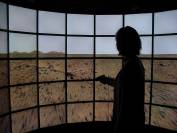
Varrier
|
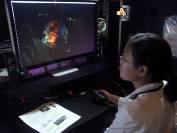
Personal Varrier
|
EVL has a 10-camera Vicon motion capture studio that we set up last
summer. We also have a small eye-tracker for evaluating gaze issues.
EVL
has a persistent
10 Gigabit Ethernet (GE) connection to the University of
Washington in Seattle and the University of California in San Diego via
its own private wavelength on the National LambdaRail infrastructure.
EVL works with Argonne and Northwestern University to operate the
StarLight facility in downtown Chicago, a 1GE and 10GE switch/router
facility as a proving ground for
network services optimized for high-performance, large-scale national
and global applications to Europe and Asia. EVL uses these facilities
to develop new
protocols that take advantage of these networks and investigate
collaborative sharing of high-resolution
video and scientific datasets.
Current EVL Projects
There is a pretty full list at: http://www.evl.uic.edu/cavern/
which shows the variety of projects we are involved in. Here are some
of the projects that I am currently invovled with, to
give you an idea of some of the things the students in our lab work on:
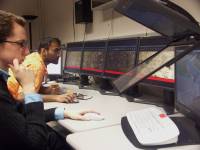
CoreWall -
EVL is working with several different core drilling groups including
the ANDRILL project in Antarctica to help them visualize, annotate, and
study core samples digitally in high-resolution.
|
 |
Water Table
- EVL is working with the Science Museum of Minnesota to create a
multi-user table-based interactive visualization of water flow across
North America
for their travelling 'Water Planet' exhibit.
|
|
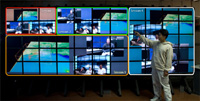
SAGE - EVL
is developing software to share and interact with multiple
high-resoluition images, animations, and video (such as data from the
US Geologic Survey and
the National Institute for Microscopy and Imaging Research) on large
cluster-driven
tile display systems.
|
 |
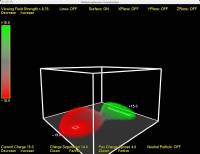
Nanoscience
Education - EVL is working with Northwestern University, the
University
of Michigan, and many others to improve high-school and college level
education in nanoscience. In particular, we are looking at
self-assembly at the nano-scale.
|
 |
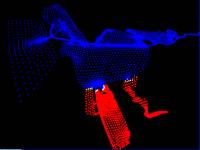
Corpus
Christi Bay Visualization - EVL is working with the University
of
Illinois at Urbana Champaign to visualize salinity and oxygen levels in
Corpus Christi Bay, Texas.
|
 |
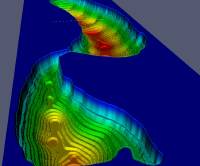
Lake Bonney
Visualization - EVL is working with NASA on the
visualization of the geochemistry and biology of the ice-covered Lake
Bonney in Antarctica.
|
 |
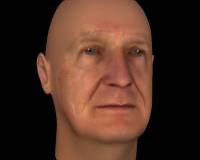
LifeLike -
EVL is working with the University of Central Florida to combine
artificial intelligence and computer graphics to create more life like
interactive computer generated representations of individuals to
preserve their knowledge.
|
 |
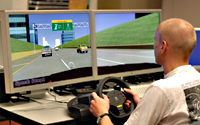
Driving
Simulator - EVL is working with the Chicago tollway authority
and
O'Hare airport on driving simulators using high-resolution LCD panels
to give drivers roughly 20/20 vision in the simulator.
|
 |
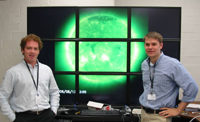
Solar
Visualization - EVL is working with the Naval Research Lab on
the
visualization of stereoscopic data of solar phenomena from NASA’s Solar
Terrestrial Relations Observatory (STEREO) mission, a pair of
satellites launched in October 2006 that began circling the Sun in
January 2007.
|
 |
Possible
Thesis Topics
Here are some ideas
for Milan Thesis work. There are many more possible ones, but this may
give you some ideas.
- Intelligent
avatar (head, head and upper body, or full body) that you can talk to
that will answer your questions (might be a person at a museum that
tells you about the exhibit.) This would involve using motion capture
data and physics to animate a human head or body, voice recognition
(and perhaps camera recognition) to listen to the user, artificial
intelligence and some database work to know how to generate an answer,
and then speech synthesis for the avatar to talk back. Doing all of
this is a big hard problem, but it would be possible to do a part of
this.
- Whole
city/driving simulator with traffic, lights and pedestrians. We have
done smaller driving simulators but not one in a dense area. There are
some nice city models available for purchase but they are static.
Automobile and pedestrian models are available. It would be nice to
create a dynamic cityscape for people to drive through. This would
involve creating a large number of agents (people on the street, people
in cards), and animating the elements of the city that are near the
driver. Maybe this application is collaborative between a 'driver' at a
large screen PC and a pedestrian in a VR device, where they both share
the same city.
- Evacuation
simulation. We are working with the City of Chicago and Argonne
National Labs on how to model the evacuation of a tall building in
downtown chicago, or even the evacuation of the entire downtown area in
the event of something bad happening. Whereas the driving simulation is
interactive, this larger set of agents would be run as a simulation on
large cluster computers to generate visualizations in 10 or 15 minutes
that could be played back.
- Dynamic
data
overlays for our interactive table. We currently have interactive maps
on our 6-tile table. We could use this for maps of Chicago / US / Italy
/ Europe / World. We can currently zoom in/out and rotate the map. It
would be good to add more interesting dynamic data to this map such as:
weather, traffic, crime, earthquakes, floods, disease outbreaks. This
would involve writing code to access the on-line data, convert it to a
usable form, apply it as a user-friendly layer onto the maps on the
table, and allow users to query for more information.
Related
Links
http://www.evl.uic.edu
http://www.evl.uic.edu/cavern/
http://www.geowall.org
http://www.cs.uic.edu
If you have further questions you can email me at aej at
evl.uic.edu
Last updated 5/10/08