
SMART: A Surrogate Model for Predicting Application Runtime in Dragonfly Systems
January 20th, 2026
Categories: Software, Supercomputing, Machine Learning, Data Science, High Performance Computing
Authors
Wang, X., Lodi Rizzini, P., Medya, S., Lan, Z.About
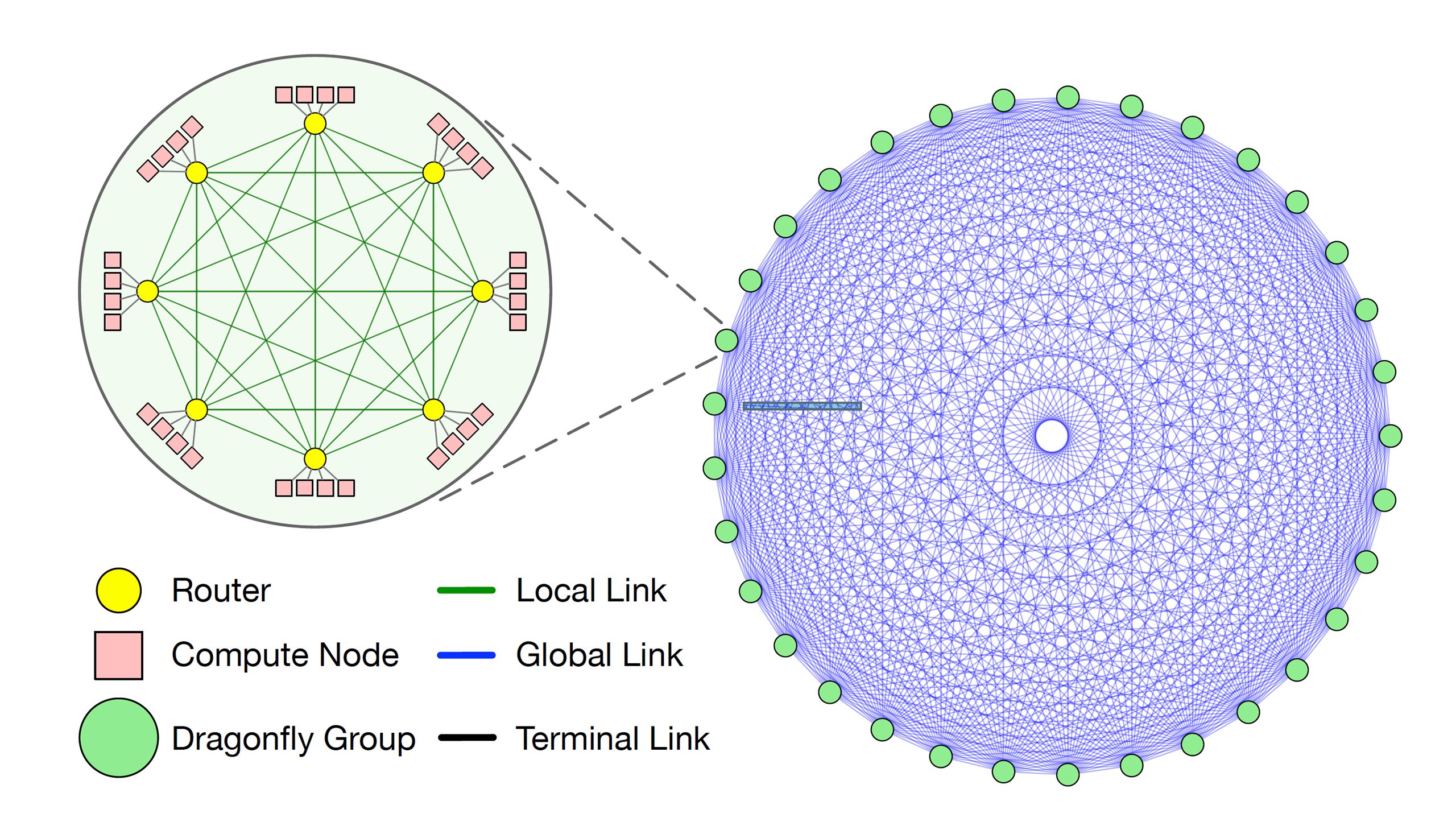
The Dragonfly network, with its high-radix and low-diameter structure, is a leading interconnect in high-performance computing. A major challenge is workload interference on shared network links. Parallel discrete event simulation (PDES) is commonly used to analyze workload interference. However, high-fidelity PDES is computationally expensive, making it impractical for large-scale or real-time scenarios. Hybrid simulation that incorporates data-driven surrogate models offers a promising alternative, especially for forecasting application runtime, a task complicated by the dynamic behavior of network traffic. We present \ourmodel, a surrogate model that combines graph neural networks (GNNs) and large language models (LLMs) to capture both spatial and temporal patterns from port level router data. \ourmodel outperforms existing statistical and machine learning baselines, enabling accurate runtime prediction and supporting efficient hybrid simulation of Dragonfly networks.
Resources
URL
Citation
Wang, X., Lodi Rizzini, P., Medya, S., Lan, Z., SMART: A Surrogate Model for Predicting Application Runtime in Dragonfly Systems, Association for the Advancement of Artificial Intelligence (AAAI 2026), Singapore, January 20th, 2026. https://doi.org/10.48550/arXiv.2511.11111