
Advancing Normal Tissue Complication Probability Modeling with Supervised Contrastive Learning for Predicting Osteoradionecrosis
March 23rd, 2026
Categories: Applications, Software, User Groups, Visualization, Visual Analytics, Data Science
Authors
Anyimadu, E. A., Zhang, X., Fuller, C., Marai, G. E., Canahuate, G.About
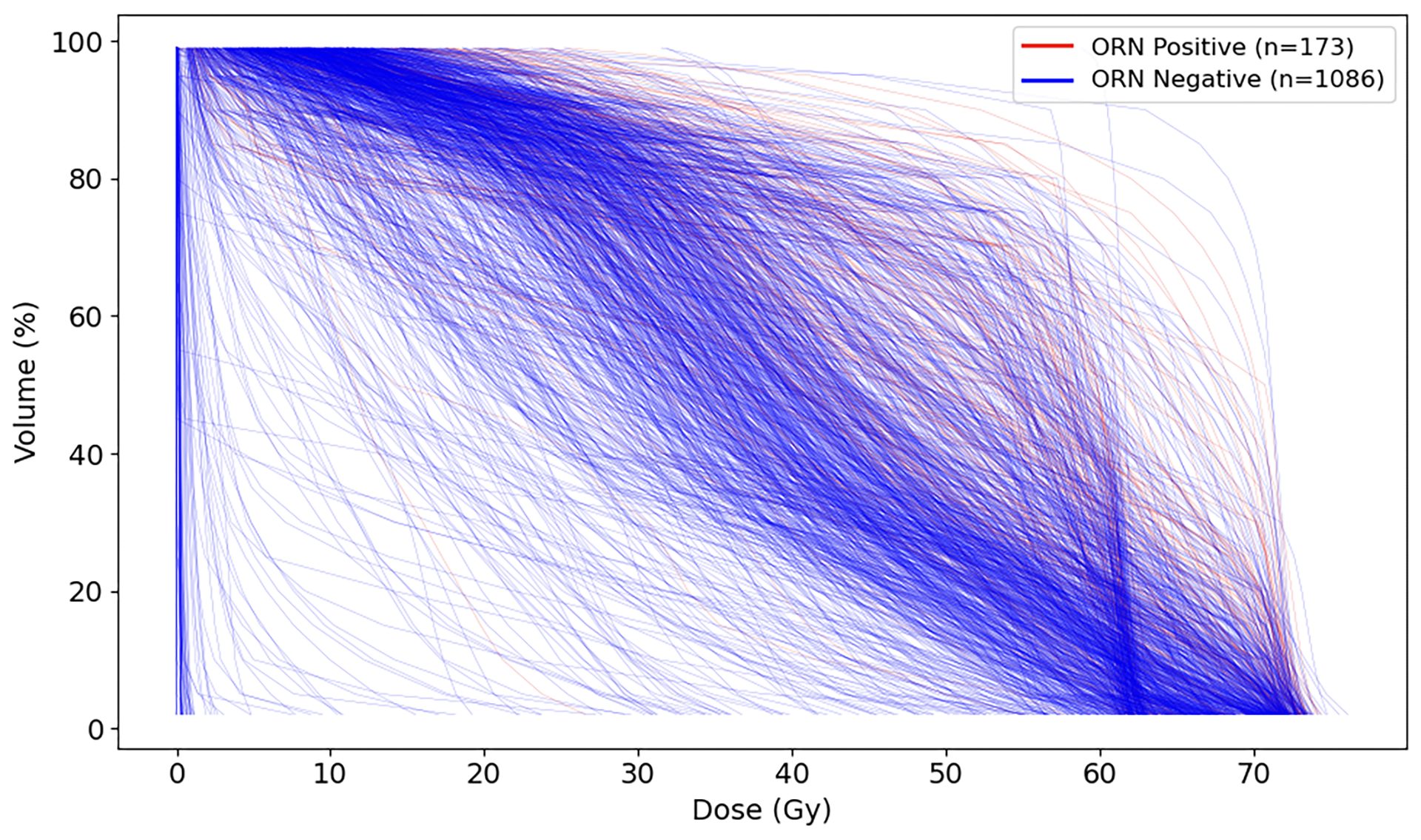
Normal tissue complication probability (NTCP) modeling using dose–volume histograms (DVHs) is fundamentally challenged by high dimensionality, severe multicollinearity, and substantial overlap between DVH profiles of patients with differing toxicity outcomes, limiting the effectiveness of classical classification approaches. We introduce SC–NTCP, a supervised contrastive learning framework that transforms DVH data into a compact, separable latent representation optimized for predicting osteoradionecrosis (ORN) in head and neck cancer patients. Rather than relying on raw, high-dimensional DVH features, SC–NTCP explicitly maximizes intra-class similarity and inter-class separability within the embedding space, enabling more accurate downstream classification. Using a cohort of head and neck cancer patients, we benchmarked SC–NTCP against logistic regression, support vector machines, multilayer perceptrons, and convolutional neural networks. SC–NTCP demonstrated superior discrimination (AUC = 0.77), improved calibration, and enhanced interpretability via gradient based feature attribution, while the integration of clinical covariates further augmented predictive performance. By addressing the inherent limitations of DVH data, SC–NTCP offers a principled and interpretable approach for robust radiation toxicity prediction, with the potential to inform personalized treatment planning and improve clinical outcomes.
CCS Concepts
Computing methodologies - Representation learning; Supervised learning.
Keywords
Contrastive Learning, Normal Tissue Complication, Osteoradionecrosis, Dose-Volume Histogram
Resources
URL
Citation
Anyimadu, E. A., Zhang, X., Fuller, C., Marai, G. E., Canahuate, G., Advancing Normal Tissue Complication Probability Modeling with Supervised Contrastive Learning for Predicting Osteoradionecrosis, The 41st ACM/SIGAPP Symposium on Applied Computing (SAC ’26), Thessaloniki, Greece, ACM, New York, NY, USA, pp. 8, March 23rd, 2026. https://doi.org/10.1145/3748522.3779983